Artist Statement
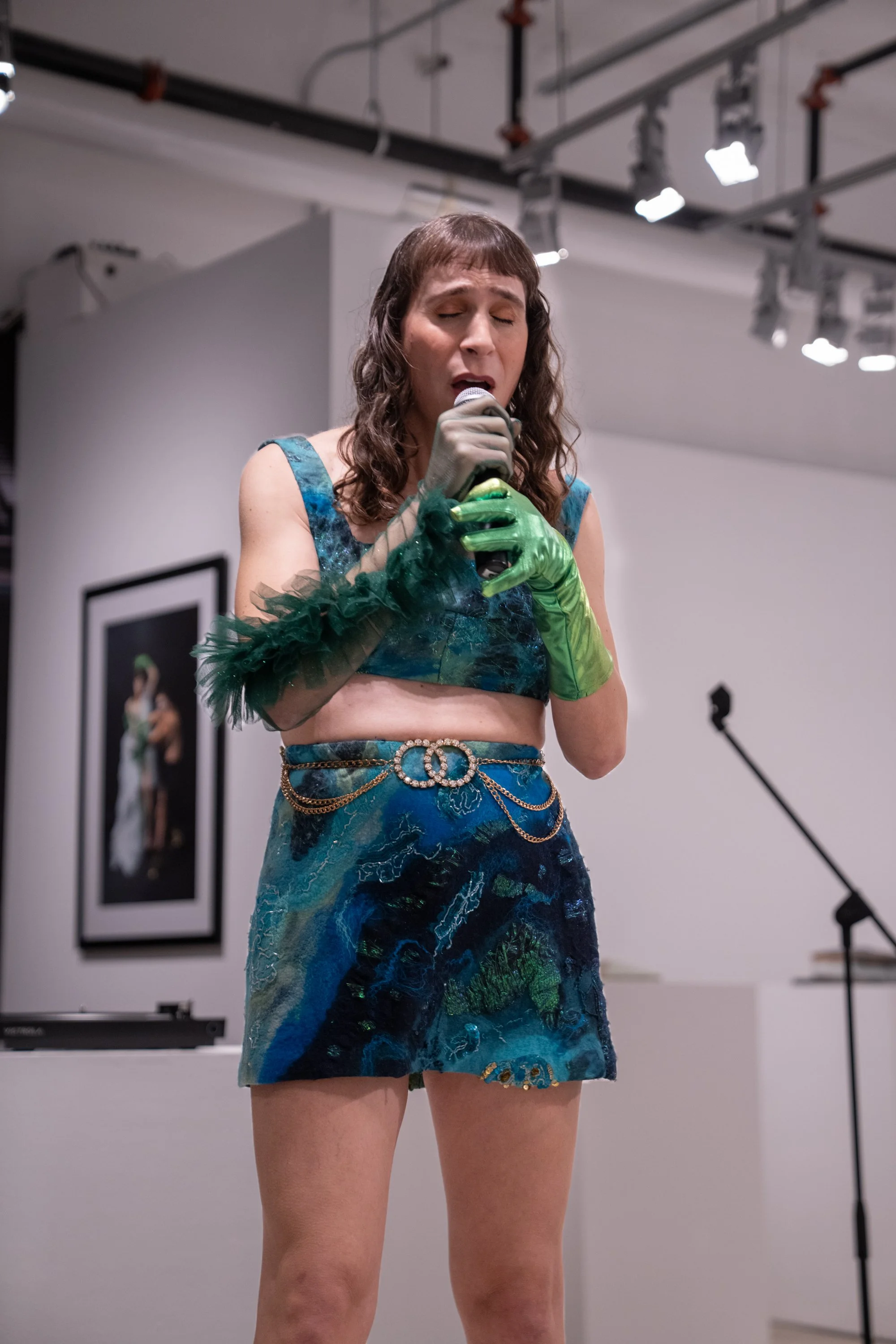
Performance documentation, The Zone of Pure Doubt
photography: Kyle S. Dunn
What does it mean to follow a ghost? And what if this came down to being followed by it, always, persecuted perhaps by the very chase we are leading? Here again what seems to be out in front, the future, comes back in advance from the past, from the back.
— Jacques Derrida, Specters of Marx
I make work in conversation with ghosts—erased histories, disavowed desires, repressed identities, places and people rendered absent by violence. Because the ghosts of injustices past and present are here, now—they’ve come back to demand justice. Working across installation, performance, film/video, writing, and music, I create embodied encounters with language that take seriously those demands for justice, enabling viewers to feel the presence—and grapple with the consequences—of that which has been rendered absent by history's so-called victors.
I use emerging technologies such as 3D scanning, generative AI, and augmented reality, treating them not as neutral instruments but as historically situated materials developed within the orbit of the military, surveillance, and big tech. In my work, technology serves as an artistic medium through which the ghosts of past, present and future are conjured to support us in making space for that which is difficult to hold: grief, complicity, displacement, intimacy, the memory of a home that is no longer, or that is no longer yours. I'm drawn to fragments and palimpsests, to the way a partial image or broken text can carry a whole field of missing language. Rather than offering explanations or solutions, I try to build conditions for a different kind of attention—one that listens for what's been interrupted, obscured, or systematically silenced.
Collaboration and community engagement are central to my practice—not only as a methodology, but as an ethos grounded in queer and trans traditions of solidarity and mutual aid. I think of collaboration as a commitment to relation and accountability, and as a way of resisting extractive habits of making. When my work engages voices beyond my own—as it often does—my aim is not simply to "include" them, but to create ethical structures in which those voices can be centered and carried with care.
To follow a ghost is to accept that you are already implicated. My work doesn’t try to resolve haunting; it asks what it might mean to respond—to stay with what remains unfinished, and to let the future arrive, as Derrida suggests, “from the past, from the back.”